

This guide will help you plan a Calm and Scenic anchor day that actually feels calm and scenic.
No specific locations. No "must-see" lists. Just the logistics, timing, and mindset that make a Wanderer day work.
DOWNLOAD YOUR PLANNER
Use this planner to help map your ideal anchor day, choose stops, and keep planning simple.
Or keep reading below!
THE MINDSET
What Makes a Wanderer Day Work
The mistake most people make: treating a scenic drive like a commute with prettier windows. They pick a destination, map the fastest route, and rush to get there.
A Wanderer day works differently. The drive is the point. The destination is optional.
That means you're not optimizing for miles covered. You're not racing to "make it" somewhere by a certain time. You're building in room to stop, linger, and change your mind.
THE PLAN
Building Your Anchor
Pick a route, not a destination.
Instead of asking "where should I go?" ask "which direction feels interesting?" Then find a road that goes that way and see where it takes you.
Roads marked as scenic byways (not highways)
Roads that follow rivers, valleys, or ridgelines
Roads with "gap" or "hollow" in the name
Know where you can actually stop.
A beautiful road with no pull-offs is just a long commute. Before you go, look for:
Overlooks or official scenic viewpoints
Wide shoulders or small parking areas
Covered bridges (almost always have parking)
Country stores or farm stands along the route
If you can't find at least 3-4 places to stop, pick a different route.
Pair the drive with one or two low-key stops.
A Wanderer day isn't about stacking activities. But you'll want to get out of the car a few times. Good pairings:
A covered bridge you can walk through
A country store for a snack
A short walk (15-30 minutes) to stretch your legs
A spot with a view where you can sit
That's it. Don't add more.
THE RHYTHM
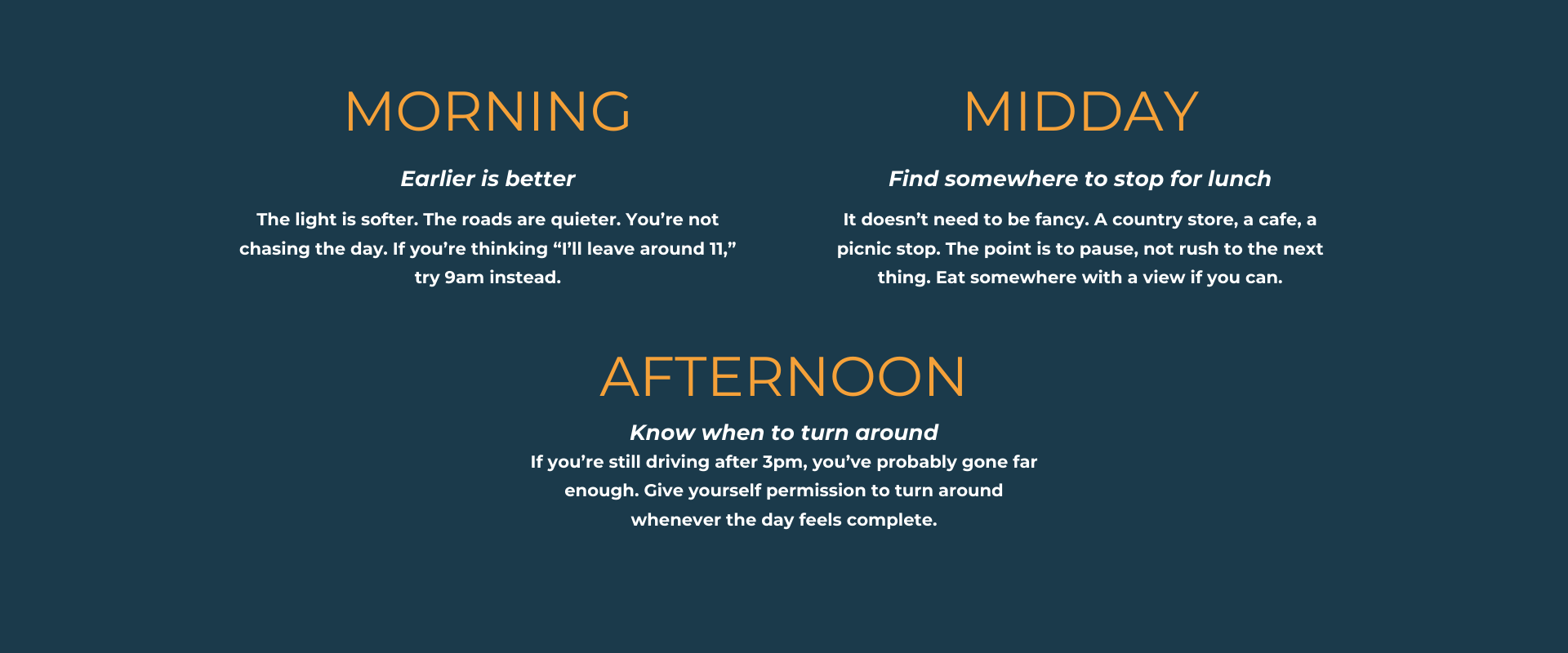
BEFORE YOU GO
Practical Tips
✔ Gas up before you go
Back roads don't have gas stations when you need them. Start with a full tank.
✔ Bring snacks and water
You won't want to stop at a convenience store mid-drive. Pack something simple.
✔ Check the weather
Overcast can be beautiful. Snow, ice or fog on a mountain road changes the plan. Look before you go.
✔ Bring a paper map or download offline maps
Cell service disappears on back roads. Have a backup.
✔ Charge your phone, but put it away
Use it for photos and emergencies. The point is to wander, not follow a blue line.
WATCH OUT
Common Mistakes
① Trying to loop back by a specific time
This turns a Wanderer day into a deadline. Build in buffer, or accept that you might retrace your route.
② Stacking "quick stops" that break the rhythm
Every time you get out of the car, you lose 20-30 minutes. Three stops is plenty. Five is too many.
③ Driving too fast to actually enjoy it
Scenic roads aren't about getting somewhere. Slow down. Let cars pass you if they want.
④ Planning a destination and rushing to get there
If you catch yourself thinking "we need to make it to [X] by noon," you've stopped wandering.
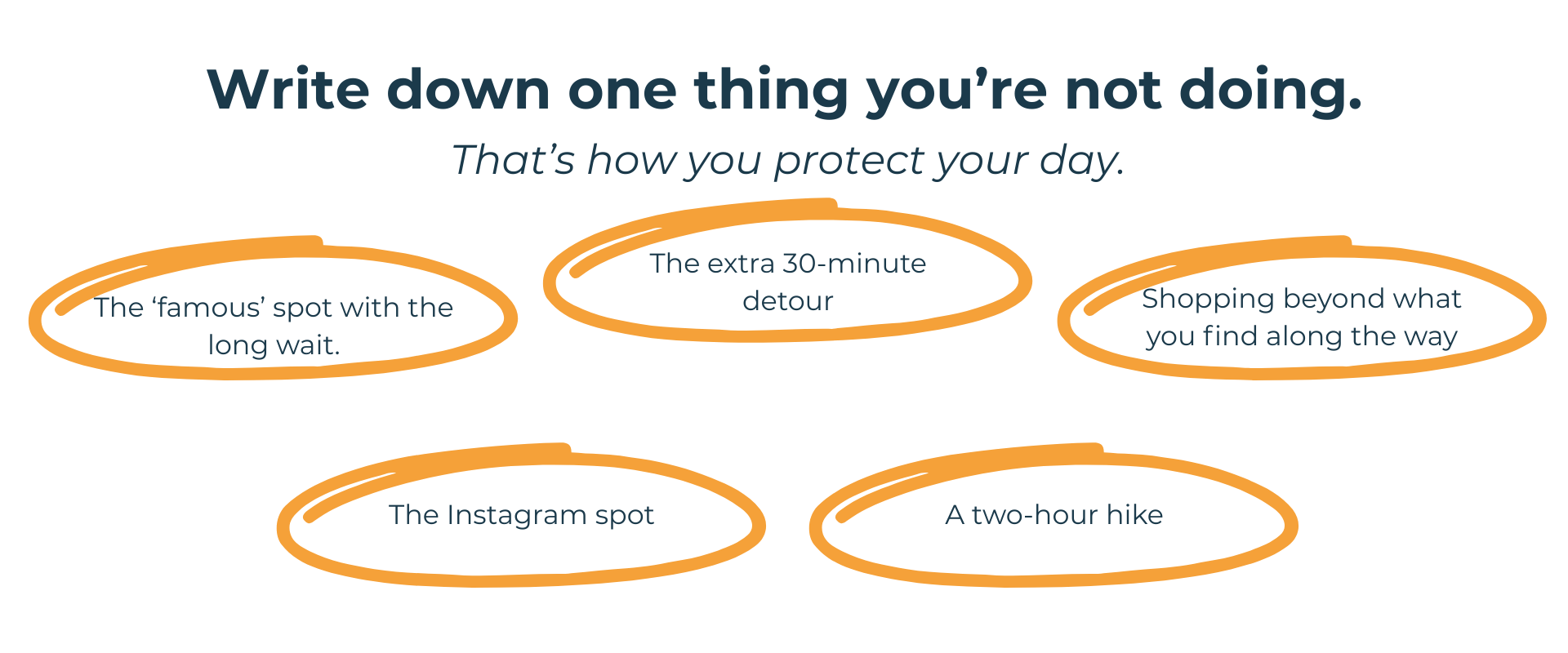
PROTECT YOUR DAY
What to Skip
SKIP THE PLANNING
Want it fully handled?
If you'd rather not think about routes, timing, or where to pull off, you can hand the whole day off.
Someone who knows which roads are actually worth driving
The stops that locals know and tourists drive past
A day that flows because the route was built by someone who's driven it a hundred times
You relax and look out the window instead of staring at your phone